- Trusted electric drive solutions
- 35+ years of innovation expertise
- Built-in integration & retrofit


Patient hoists play an essential role in healthcare and social care. Although they take over the lifting itself, moving the hoist still demands physical effort. This is especially true in confined spaces such as bathrooms or patient rooms. A power-assisted patient hoist with a power assist wheel provides a practical and ergonomic solution to reduce that strain.
A power-assisted hoist includes an electrically driven castor that is built into the system. It works together with sensors in the push handle that respond to the healthcare professional’s natural push force. As a result, the integrated drive system offers smooth, intuitive support during movement. This helps caregivers move the hoist with much less effort.
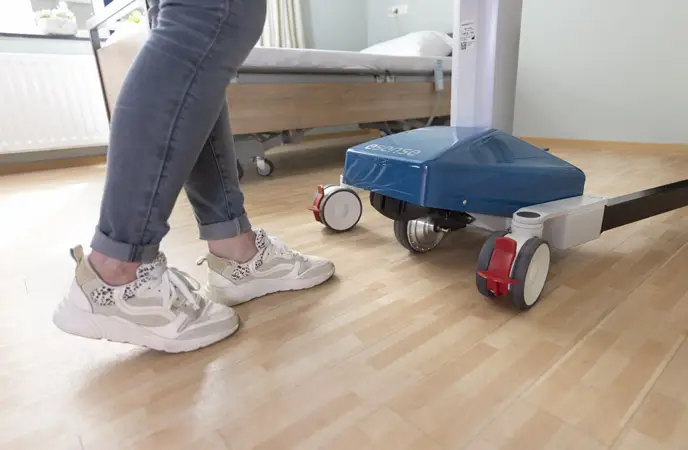
Reduced physical strain
Electric drive support minimises push and pull forces, helping reduce physical strain and the risk of musculoskeletal disorders (MSDs) among healthcare professionals.
Easy to manoeuvre in tight spaces
The hoist’s agile design and motorised support make it ideal for use in small patient rooms, bathrooms, and other confined areas.
Single-person operation
Electric drive support can make it easier for one healthcare professional to manoeuvre the patient lift, where appropriate for the transfer and care situation.
Closer staff-patient interaction
The healthcare professional can walk alongside the patient hoist during transfers, allowing for better communication and control.
Supports sustainable staffing
Reducing physical strain can support staff wellbeing, lower sickness absence and a more sustainable healthcare workforce.
Improved efficiency
Transfers are faster and easier, helping streamline daily workflows in care environments.
Reducing push and pull forces also supports safer manual handling in line with HSE guidance for the UK healthcare and social care sectors. In short, a power-assisted patient hoist can reduce physical effort and support safer, more efficient patient handling.

 Vraag brochure aan


